PROMOTED by


On September 1, Xi Jinping began his three-day state visit to Egypt, returning to the country after more than a decade. Shortly before his arrival, an article signed by the Chinese President was published across Egypt’s flagship state-owned dailies – Al-Ahram, Al-Akhbar, and Al-Gomhuria. Xi’s article highlighted the 70th anniversary of the establishment of diplomatic relations between China and Egypt, and unsurprisingly, struck a celebratory tone, emphasizing the two countries’ long civilizational histories, their commitment to “win-win” cooperation, Egypt’s crucial role in China-Africa and China-Arab relations, and the achievements and shared stances that have come to define the relationship.
Xi was hardly the sole voice praising China in the Egyptian press. Egyptian officials were equally eager to underscore the importance of both the visit and the bilateral relationship. Egypt’s State Information Service (SIS), the Egyptian Presidency’s official media organ, went as far as to publish a book specifically for the occasion, authored by its chairman, Ambassador Alaa Youssef.1
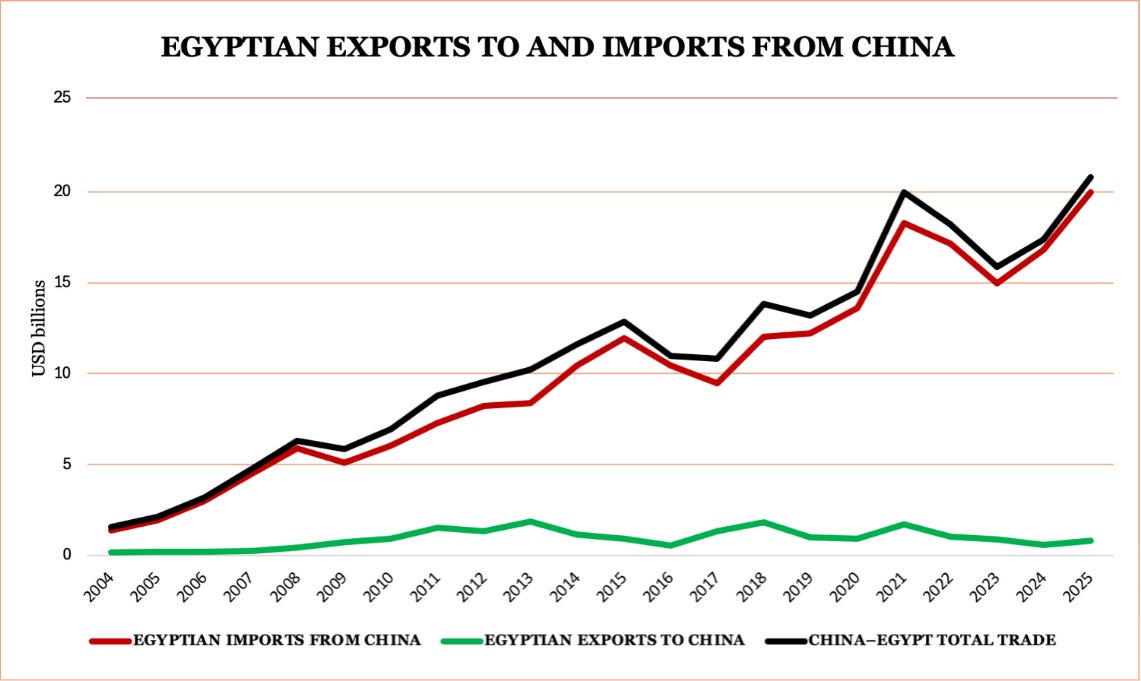
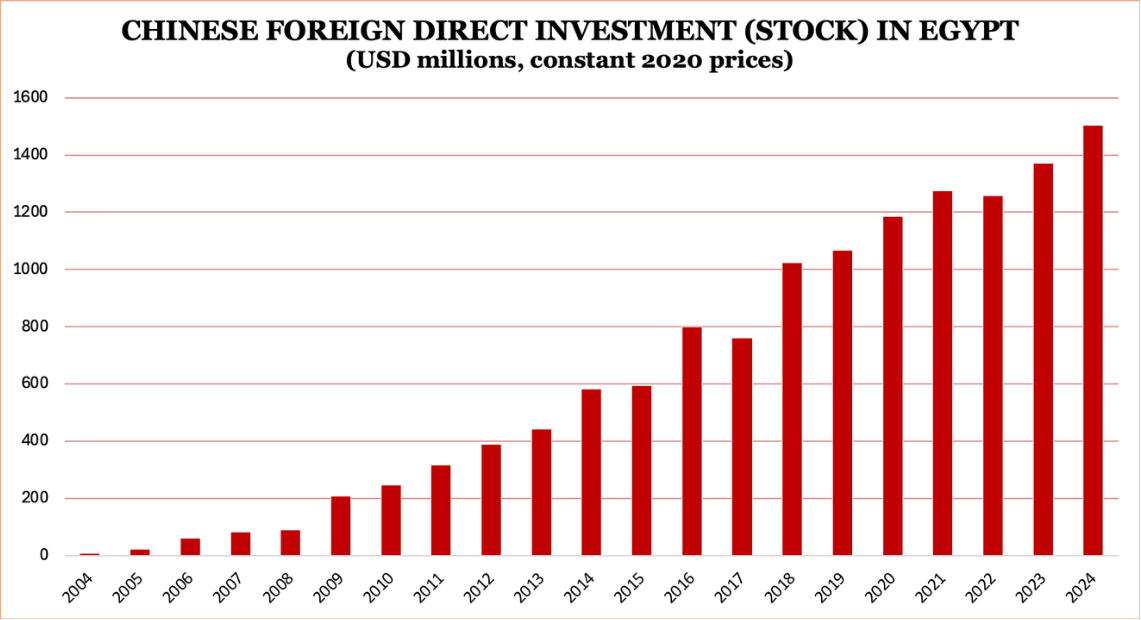
Beyond the platitudes of Egyptian and Chinese officials, the visit attracted significant attention from international media, particularly elsewhere in the Middle East. In an explainer on Xi’s visit for Al Jazeera, journalist Usaid Siddiqui noted how the economic relationship has expanded since 2014, when the two countries elevated their ties to a “comprehensive strategic partnership.” China is now Egypt’s largest trading partner in non-petroleum goods, with bilateral trade reaching nearly $20.7 billion by the end of 2025. The stock of Chinese foreign direct investment in Egypt has also risen to $1.85 billion in 2024, with Chinese investment concentrated in areas such as Egypt’s New Administrative Capital and the Suez Canal Economic Zone, the latter at the center of several memoranda of understanding signed during Xi’s visit.
Siddiqui, like many others, also placed the visit in its regional context. Xi arrived in Cairo amid the U.S.-Israeli war on Iran as well as Saudi Arabia, Pakistan and Türkiye’s decision to sign the Mecca Agreement, a mutual defense pact. Egypt had been identified by many observers, including Chinese analysts, as a potential participant. However, Cairo’s longstanding military and security dependence on the U.S., and its complicated relationship with Israel, likely made any straightforward realignment unlikely in the short term.
International coverage of Xi’s visit also noted China and Egypt’s convergence on issues including Taiwan, the Nile and the wars in the Middle East alongside bilateral currency swaps and military cooperation, most notably the recent Eagles of Civilization 2026 joint air force exercise. Yet it was the growing technological dimension of the relationship that attracted extensive attention. Several outlets highlighted cooperation in satellite assembly, telecommunications equipment and, above all, artificial intelligence. Outlets like Al Jazeera, The New Arab, Al Hurra and Al Monitor have all framed these developments as part of the wider technological competition between China and the United States.
Here, Zayed University’s Jonathan Fulton, writing in his China-MENA Newsletter, offered a different perspective. The U.S.-Egypt relationship, he argued, is “very sturdy and important,” spanning a breadth of issues that China “isn’t anywhere close to” matching, even as Beijing has become an important complementary partner.
The question, then, is how Egyptian experts themselves understand this expanding relationship. Do they see Cairo as being drawn into a contest between Washington and Beijing, or as using ties with both powers to widen its own room for maneuver? The Egyptian commentary examined in this issue of the ChinaMed Observer points more clearly toward the latter interpretation.
Xi’s visit was welcomed by Egyptian analysts as an opportunity to deepen both political and economic ties with Beijing, with several of them portraying Egyptian President Abdel Fattah Al-Sisi and his cabinet as having successfully navigated great power competition by leveraging Egypt’s distinctive geographic, demographic and economic characteristics. While this interpretation should be read with a grain of salt given the constraints of Egypt’s media environment, Xi’s decision to travel to Cairo, and the concern the visit received from Western outlets, underscore Egypt’s growing value as a partner that both Beijing and Washington have an interest in courting, especially in strategically sensitive sectors such as artificial intelligence.
By analyzing the Joint Communiqué issued at the conclusion of the three-day visit,2 it is possible to identify key foreign policy priorities shared by the two parties, namely “strategic hedging” and “independence from foreign policy patrons,” concepts that resonate deeply into the Egyptian media environment.3As Dr. Ahmad Qandeel – Deputy Director of the Al-Ahram Center for Political and Strategic Studies, a leading independent “state-friendly” Egyptian think tank – pointed out:
“Egypt and China are both members of BRICS, and Egypt is a dialogue partner in the Shanghai Cooperation Organization, yet Cairo maintains deep strategic ties with the United States and Europe. I see no contradiction in this: for the world that best suits China is not necessarily one that revolves around Beijing, but rather one that does not revolve entirely around a single capital. This aligns with Egypt’s interest in diversifying its options without becoming beholden to specific geopolitical blocs.”4
Building upon the same premises, Muhammed Sabreen, a managing editor at Al-Ahram, offered a more “geopolitical” interpretation:
"While Egypt may not be the largest Arab economy, it combines […] attributes rarely found together elsewhere: a strategic location bridging Asia, Africa, and Europe; the Suez Canal; a massive domestic market; an expanding industrial base; extensive networks across the Arab world and Africa; and a direct political role regarding the issues of Palestine, Sudan, Libya, and the Red Sea. […] For its part, Beijing views Egypt as a partner capable of […] accessing markets and regions that China cannot reach as easily through its own direct bilateral relations.”5
In Cairo, Xi also introduced China’s Regional Security Initiative, a four-point plan that places regional actors at the heart of the project. Qandeel contrasts the Chinese approach with the American concept of “umbrella,” which “belongs to the party holding it.” As he put into words:
“The choice of Cairo as the venue to announce the Chinese regional security initiative carries special significance. Egypt is […] a key player in the equations concerning Palestine, the Red Sea, and the Eastern Mediterranean, maintaining balanced relations with China, the United States, and various regional powers. […] Egypt’s interest lies not in replacing one international partner with another, but rather in establishing an open system that expands its room for maneuver and safeguards regional security against the shifting priorities of major powers.”6
As for the economic outcome of Xi’s visit to Cairo, Egyptian commentators reacted positively, pointing out a major qualitative shift in the Cairo-Beijing partnership toward localization and transfer of technologies, in line with Egypt’s Vision 2030 and China’s Belt and Road Initiative.
Writing about this strategy, Muhammed Sabreen cited plans of a major Chinese aluminum company to invest up to $2 billion in an integrated industrial complex within the Suez Canal Economic Zone (SCZONE) as an evidence that: “China is no longer content with merely selling its products to the Egyptian market; Chinese investments are gradually moving toward manufacturing, production, and exporting.” Crucially, Sabreen noted that the Egyptian government stipulated that the project must include the transfer of expertise and advanced technology, and rely on clean energy.7
According to Muhammad Al-Muhandis, Chairman of the Chamber of Engineering Industries at the Federation of Egyptian Industries, the Egyptian–Chinese industrial zone in the SCZONE can bolster Egypt’s domestic supply chains by reducing its reliance on imports, while attracting investments in vital sectors such as home appliances, feeder industries, automotive manufacturing, and renewable energy:
“Cooperation with the Chinese side aims to leverage the advanced technological expertise and competitive production capabilities of Chinese companies to localize the manufacturing of production components and reduce reliance on imports.”8
Furthermore, the two parties agreed to increase the value of the existing currency swap agreement, raising it from approximately RMB 18 billion to the 30 billion agreed upon during the presidential visit. Providing a direct liquidity mechanism in both currencies can enable businesses and banks to conduct commercial transactions with greater flexibility, while fostering an environment more conducive to companies wishing to establish trade relations with the other party, with the ultimate goal of increasing the already substantial number of Chinese firms in the SCZONE (approximately 200).9
The agreement was reached at a pivotal moment in trade relations between Cairo and Beijing: the data provided by Abdel Aziz Al-Sharif, First Undersecretary of the Ministry of Investment and Foreign Trade, show that the value of Egyptian exports to China grew by 55.2%, reaching over “$660 million during the period from January to July 2026, compared to $425.6 million during the same period in 2025.”10
Against this backdrop, capital market and investment expert Atef Al-Sherif argued that the significant amount in announced Chinese investments, “exceeding $52 billion,” alongside a record 30 new projects in 2025, underscores Egypt’s “pivotal role as a regional hub for trade and investment and a key corridor for the Belt and Road Initiative.” He further emphasized that establishing a practical framework to implement the joint agenda reflects the seriousness of both sides in translating mutual understanding into tangible projects on the ground.11
Through Vision 2030, Egyptian policymakers are convoying efforts and resources in the development and localization of cutting-edge technologies, mainly artificial intelligence and cloud computing facilities, with national data centers at the core of this strategy. Egypt’s AI ambition parallels initiatives pursued by other regional powers seeking to strengthen digital sovereignty. In this context, the timing of two developments during Xi’s visit reveals the opportunities and risks facing Cairo as it pursues this agenda amid intensifying U.S.-China competition.
Coinciding with Xi’s visit, Egypt’s National Telecommunication Institute signed an agreement with the American technology conglomerate Cisco Systems to train Egyptian faculty members and independent lecturers in data networks, cybersecurity, operating systems and AI, in order to increase the number of instructors qualified in these subjects.12
Meanwhile, at the conclusion of the three-day visit, Egypt and China issued a joint communiqué pleading to expand cooperation on advanced technologies, including cloud computing, data centers, the data-driven economy, and semiconductors, while facilitating the transfer of technological expertise in computing and digital manufacturing.13
The juxtaposition is striking as it illustrates the room for maneuver available to Cairo between great powers. While the Cisco agreement presents concrete commitments to developing Egypt’s AI-related human capital, the China-Egypt joint statement has established a broader framework for future collaboration. Aly Mahmoud, a managing editor at Al-Ahram, enthusiastically interpreted the two agreements as evidence of what he describes as a “hybrid” Egyptian approach to AI – one that draws on technological expertise from both the United States and China:
“In short, by leveraging its relationships with the two competing powers in this sector, Egypt has successfully tapped into the expertise of both nations to craft a unique, ‘hybrid’ program in information technology and artificial intelligence. The resulting framework is fully secure and ensures Egypt’s digital sovereignty with the highest standards of safety and operational efficiency, while bypassing the restrictive measures Washington imposes to block the transfer of its chip-manufacturing and AI-specific data chip technologies to various countries, most notably China.”14
Yet, the flexibility that allows Egypt to draw on both sides of the great power rivalry may also expose it to the pressures generated by that competition. The experience of the Emirati AI company G42 offers a warning of how quickly the room for maneuver may narrow: after securing multi-million dollars agreements with Chinese entities across multiple sectors15 while also relying on U.S. technologies such as VAST Data’s computing infrastructure,16 mounting scrutiny from U.S. national security agencies led it to divest from all its Chinese investments in order to maintain access to American technology.
The G42 precedent remains relevant as Egypt continues to pursue its strategy of becoming a regional hub for AI development. According to the Ministry of Communications and Information Technology, the sector recorded a growth rate of 24.3% during the fourth quarter of the 2025-26 fiscal year, the highest rate on record.17 This growth was mainly driven by software development and outsourcing, underpinned by Egypt’s young and highly skilled workforce and its growing pool of programming and technical talent. For Ahmed Hassan Elzaher, CEO of Egypt’s IT Industry Development Agency, this human capital is a key driver of the country’s AI ambitions:
“Egypt graduates around 50,000 engineers and computer science graduates annually. This creates one of the largest technical talent pools in the MENA region — multilingual, cost-competitive, and increasingly specialized in digital technologies. […] Our scale allows companies to build AI implementation teams quickly, particularly in applied engineering, data analytics, NLP, and AI system integration. Through structured upskilling programs and partnerships with global technology providers, we are transitioning from general ICT capacity to AI-specialized expertise.”18
As Egypt’s AI ecosystem continues to expand, these strengths make it an attractive partner for investments and cooperation in critical technologies. So far, Cairo has been able to leverage its independent foreign policy to draw technological benefits from both sides of the U.S.-China competition. Yet the G42 precedent serves as a cautionary example about the long-term risks of becoming caught amid great powers.
Overall, Xi Jinping’s milestone visit to Cairo underscores Egypt’s evolving role as an adept practitioner of strategic hedging rather than as a pawn in a rigid bipolar rivalry. The national and international press appear to share this view, highlighting Al-Sisi’s efforts to leverage the country’s strategic positioning amid geopolitical escalation between Washington and Beijing and continuing turmoil in its neighborhood. As Carnegie’s Director of the Middle East Program Amr Hamzawy put into words, “Cairo is diversifying its partnerships and cooperation schemes, including in all military and technology matters, without binding itself to a patron superpower.”
This approach has become visible in the evolution of Egypt-China relations, elevating what was once a largely transactional relationship into a broader political, economic and technological partnership. Egyptian commentators view Cairo’s geographic and demographic assets as key enablers of its industrial and AI ambitions. The expansion of the Chinese-Egyptian industrial zone along the SCZONE strengthens Cairo’s efforts to localize production; whereas in the digital sphere, cooperation with both Beijing and Washington provides access to expertise and capabilities in areas such as AI and cloud computing.
Nevertheless, the current and widely praised diplomatic equilibrium is not without risks as Egypt ventures deeper into a highly securitized domain fiercely contested by global powers. The precedents set by other regional players such as G42 suggest that maintaining an uncompromised technological ecosystem while relying on competing foreign tech giants is an increasingly delicate act. Western regulatory scrutiny and stringent embargoes regarding technology transfers could easily disrupt Cairo’s ambitious trajectory. Moving forward, Egypt’s primary challenge will be to ensure that its technological pluralism does not trigger retaliatory diplomatic friction, transforming its digital sovereignty from a strategic asset into a vulnerability.
Francesco SCALA is a Research Fellow at the ChinaMed Project. He holds a Master’s Degree in Relations and Institutions of Asia and Africa from University of Naples “L’Orientale.” His research focuses on the media coverage of China in Gulf countries.
1) State Information Service, kitāb ǧadīd li-hī’iya al-isti’alāmāt iūaṯṯiq masīra al-t’aāwun al-Maṣri al-Ṣīnī ‘alā madā 70 ‘aāman كتاب جديد لهيئة الاستعلامات يوثق مسيرة التعاون المصري الصيني على مدى 70 عامًا [New State Information Service book documents 70 years of Egyptian-Chinese cooperation], August, 31, 2026, https://sis.gov..eg/ar/المركز-الإعلامي/الأخبار/كتاب-جديد-لهيئة-الاستعلامات-يوثق-مسيرة-التعاون-المصري-الصيني-على-مدى-70-عام-اeg/ar/المركز-الإعلامي/الأخبار/كتاب-جديد-لهيئة-الاستعلامات-يوثق-مسيرة-التعاون-المصري-الصيني-على-مدى-70-عام-ا/7/.
2) SIS, “Egypt-China Joint Communiqué on the further deepening of their comprehensive strategic partnership,” September 2, 2026, https://sis.gov.eg/en/media-center/news/egypt-china-joint-communiqu%C3%A9-on-the-further-deepening-of-their-comprehensive-strategic-partnership/.
3) Al-Ahrām, nanšaru naṣṣ maqāl al-rā’īs al-Sīsī fī al-Ahrām bi-munāsiba ziyara naẓira al-Ṣīnī īlā Maṣr ننشر نص مقال الرئيس السيسي في الأهرام بمناسبة زيارة نظيره الصيني إلى مصر [We publish the text of President Sisi’s article in Al-Ahram on the occasion of his Chinese counterpart’s visit to Egypt], September 1, 2026, https://gate.ahram.org.eg/News/5918583.aspx.
4) Āḥmad Qandīl, ru’iya Maṣr - al-Ṣīn 2035 رؤية مصر – الصين 2035 [Vision Egypt – China 2035], Al-Ahrām, September 1, 2026, https://gate.ahram.org.eg/News/5918836.aspx.
5) Muhammad Ṣābrīn, sirr al-ihtimām al-duwalī bi-ziyāra Xi īlā Maṣr سر الاهتمام الدولي بزيارة شي إلى مصر [The secret behind international interest in Xi’s visit to Egypt], Al-Ahrām, September 2, 2026 https://gate.ahram.org.eg/News/5918929.aspx.
6) Āḥmad Qandīl, al-mubāḥira al-Ṣīniya li-l-āmin al-iqlīmiya: biḥīl am mukammil li-l-miẓalla al-ḡarbiya? المبادرة الصينية للأمن الإقليمي: بديل أم مُكمِّل للمظلة الغربية؟ [The Chinese Regional Security Initiative: an alternative or a complement to the Western Umbrella?], Markaz Al-Ahrām li-Dirasāt al-Sīāsiya wa-l-Istrātīǧiya [Al-Ahram Center for Political & Strategic Studies], September 6, 2026, https://acpss.ahram.org.eg/News/21808.aspx.
7) See note 5, https://gate.ahram.org.eg/News/5918929.aspx.
8) ‘Abd al-Fattāḥ Ḥiǧāb, Muḥammad al-Muhandis: al-širākāt al-istrātīǧiya m’a al-Ṣīn tumaṯṯilu furṣa ḏahbiya li-tawaṭīn al-ṣīnā’aāt al-handisiya محمد المهندس: الشراكات الإستراتيجية مع الصين تمثل فرصة ذهبية لتوطين الصناعات الهندسية [Muhammad al-Muhandis: strategic partnerships with China represent a golden opportunity to localize engineering industries], Al-Ahrām, September 3, 2026, https://gate.ahram.org.eg/News/5920304.aspx.
9) Raphael Rashīd, limādha turāḥan al-Ṣīn ‘alā Maṣr fi haḏihi al-marḥala? لماذا تراهن الصين على مصر في هذه المرحلة؟ [Why is China betting on Egypt at this stage?], Al Jazeera, September 3, 2026, https://www.aljazeera.net/politics/2026/9/3/لماذا-تراهن-الصين-على-مصر-في-هذه.
10) ‘Alā’ Āḥmad, biziyāda 55.2%... al-ṣidarāt al- Maṣriya tasaǧǧala mustawiyāt qiyāsiya fī al-sūq al-Ṣīniya بزيادة 55.2%.. الصادرات المصرية تسجل مستويات قياسية في السوق الصينية [Up 55.2%... Egyptian exports hit record levels in the Chinese market], Al-Ahrām, September 8, 2026, https://gate.ahram.org.eg/News/5923212.aspx.
11) Alā Āḥmad, ḵabīr āsūāq māl: natāʾiǧ ziyāra al-rā’is al-Ṣīnī ta’azzaza tadfuqāt al-istiṯmār al-āǧnabī wa-tafattaḥa āfaqan wāsi’a li-tawaṭīn al-tiknūlūǧiyā خبيرأسواق مال: نتائج زيارة الرئيس الصيني تعزز تدفقات الاستثمار الأجنبي وتفتح آفاقاً واسعة لتوطين التكنولوجيا [Financial Markets Expert: outcomes of Chinese President’s visit boost foreign investment flows and open broad horizons for technology localization], Al-Ahrām, September 9, 2026, https://gate.ahram.org.eg/News/5920285.aspx.
12) Matshepo Sehlolo, Egypt, “Cisco to train 3,000 AI instructors,” Connecting Africa, September 2, 2026, https://www.connectingafrica.com/ai/egypt-cisco-to-train-3-000-ai-instructors.
13) See note 3, https://gate.ahram.org.eg/News/5920304.aspx.
14) ‘Alī Maḥmūd, ḏakā’ iṣṭinā’iī haǧīn… kaifa f’alathā Maṣr? ذكاء اصطناعي هجين.. كيف فعلتها مصر؟ [Hybrid Artificial Intelligence: how did Egypt do it?], Al-Ahrām, September 9, 2026, https://gate.ahram.org.eg/News/5921860.aspx.
15) Amīr al-Sunnī, ānẓama ǧadīda li-l-ṣiḥa al-‘alāmiya taḥassun ḥiyāt al-bašir أنظمة جديدة للصحة العالمية تحسّن حياة البشر [New Global Health Systems Improve Human Lives], Al-Ḫalīǧ, December 12, 2023, https://www.alkhaleej.ae/2023-02-12/أنظمة-جديدة-للصحة-العالمية-تحسن-حياة-البشر/أخبار-من-الإمارات/أخبار-الدار; Al-Ḫalīǧ, tašḡīl al-marḥala al-ṯāniya min mašruw’i al-tanaqqul al-ḏakī fī ḡazīratī Yas wa al-Sa’diyāt تشغيل المرحلة الثانية من مشروع التنقل الذكي في جزيرتي ياس والسعديات [Operation of Phase II of the Smart Mobility Project on Yas and Saadiyat Islands], December 23, 2022, https://www.alkhaleej.ae/2022-12-23/تشغيل-المرحلة-الثانية-من-مشروع-التنقل-الذكي-في-جزيرتي-ياس-والسعديات/أخبار-من-الإمارات.
16) ‘Ammad al-Din Ḵalīl, al-ā‘lā ǧaūda fī al-‘aālam.. iṭlāq namūḏiǧ ḏakā’ iṣṭinā’ī bi-luḡa al-‘arabiya fī Abu Dhabi الأعلى جودة في العالم.. إطلاق نموذج ذكاء اصطناعي باللغة العربية في أبوظبي [The highest quality in the world… launch of an artificial intelligence model in Arabic in Abu Dhabi], Al-Ḫalīǧ, August 31, 2023, https://www.alkhaleej.ae/2023-08-31/الأعلى-جودة-في-العالم-إطلاق-نموذج-ذكاء-اصطناعي-باللغة-العربية-في-أبوظبي/يوميات-ثقافية.
17) Al-Ahrām, qafza 24.3%... kaifa āṣbaḥ qiṭā’a al-ittaṣālāt min āsr’a muḥarrakāt al-iqtiṣād al-Maṣrī? قفزة 24.3%.. كيف أصبح قطاع الاتصالات من أسرع محركات الاقتصاد المصري؟ [A 24.3% Surge: How Did the Telecommunications Sector Become One of the Fastest Drivers of the Egyptian Economy?], September 8, 2026, https://gate.ahram.org.eg/News/5923264.aspx.
18) Myriam Mikhael, “Can Egypt emerge as a regional AI hub? And what will it take to scale?,” Fast Company Middle East, February 2, 2026, https://fastcompanyme.com/technology/can-egypt-emerge-as-a-regional-ai-hub-and-what-will-it-take-to-scale/.


