PROMOTED by


As Chinese manufacturers expand their presence in Morocco, concern is mounting in Europe and the United States that the Kingdom may become an “industrial platform” for China to circumvent trade restrictions. EU trade commissioner Maroš Šefčovič framed the relocation of Chinese production to the Southern Neighborhood as a “big issue for the European economy,” arguing that Chinese overcapacity may be channeled into the bloc via third-party trade partners.1
Yet this is not the whole story. In Morocco, the expansion of China’s economic footprint is widely perceived as benefiting local development by generating employment opportunities and attracting industrial investment, especially in the emerging sectors of green technologies. Rather than a passive recipient of Chinese capital, Rabat has actively sought to channel these investments toward its own industrialization and decarbonization objectives.
This ChinaMed Observer examines the evolution of Sino–Moroccan economic ties following Morocco’s accession to the Belt and Road Initiative (BRI), focusing on Tanger Tech City as an emerging platform for green manufacturing driven by a convergence of geoeconomic interests between the two countries.
China and Morocco established a strategic partnership in 2016, during King Mohammed VI’s state visit. The following year, Rabat became the first African country to join the BRI. Since then, the value of Chinese assets in the Kingdom almost reached $750 million in 2024. Although Algeria continued to host larger volumes, Chinese FDI stock in Morocco increased more than fivefold over the same period, recording the strongest relative growth trajectory.
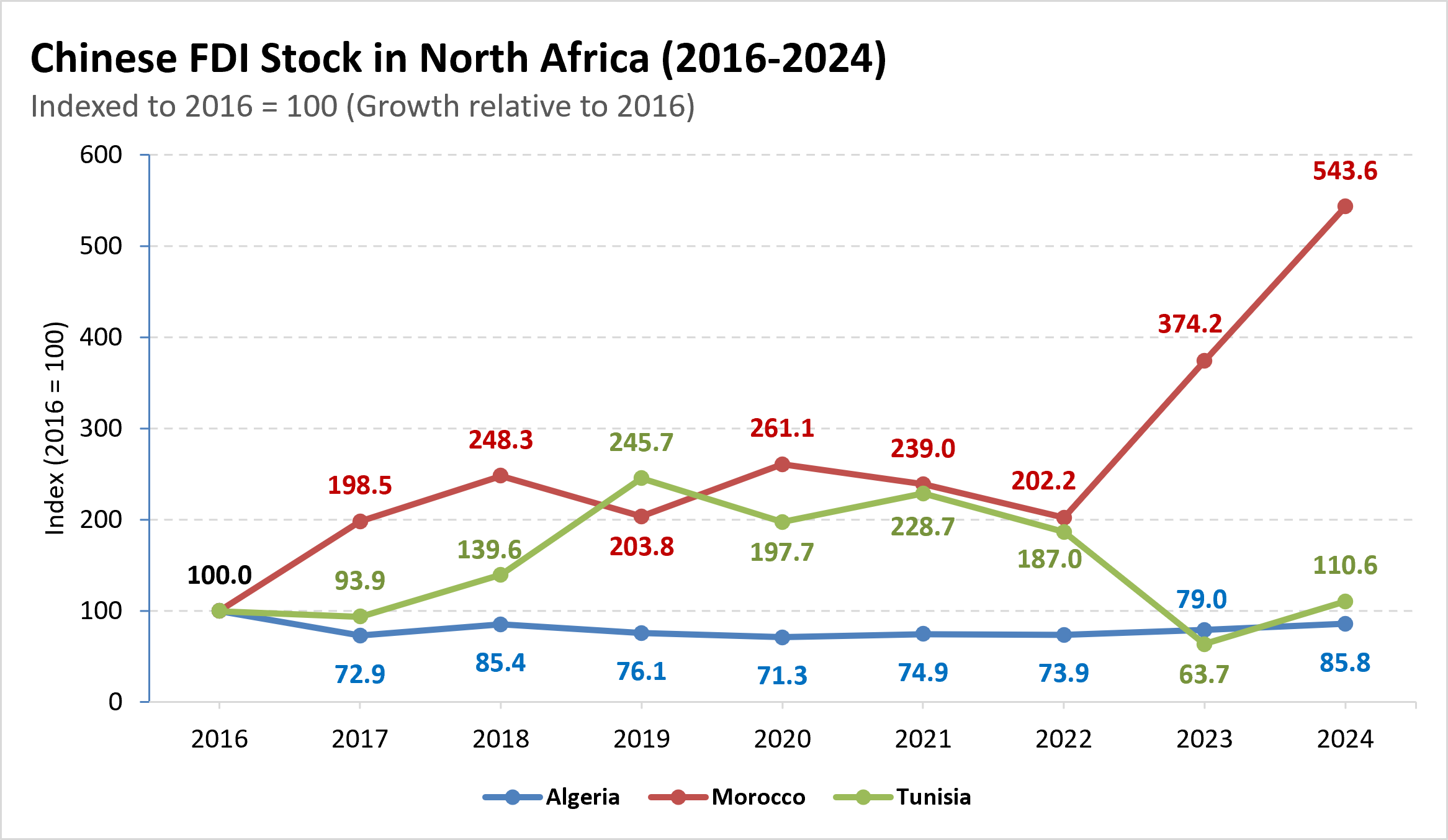
This rapid expansion strongly reflects Morocco’s attractiveness as an emerging industrial platform for Chinese manufacturers.2 The trend was driven less by traditional development finance than by private firms aligning their overseas strategy with Beijing’s new national priorities: the globalization of China’s renewable energy industry and the consolidation of the green value chain.3
Morocco holds over 70% of the world’s phosphate reserves, a key component of lithium-iron-phosphate batteries, alongside deposits of cobalt, manganese, nickel and copper.4 Combined with the Kingdom’s renewable energy potential and free trade access to European and American markets, this mineral endowment has made Morocco an attractive destination for Chinese industries linked to the green transition.
Chinese technological know-how aligns with Rabat’s decarbonization goals and ambition to become a regional hub for renewable energy production.5 Chinese firms are already involved in major projects, including the Noor solar complex in Ouarzazate6 – the world’s largest concentrated solar power plant – and a wind turbine blades factory in Nador for export and domestic needs. These strategic investments positioned Chinese companies as key players in Morocco’s path toward decarbonization.7
At the industrial level, Chinese EV component and battery manufacturers that have nearshored to Morocco benefit not only from proximity to mineral resources, but also from Rabat’s export networks and integrated automotive ecosystem spearheaded by Stellantis/Peugeot in Kenitra and Renault in Tangiers that have positioned it as Africa’s top car manufacturer.8 From Beijing’s perspective, relocating part of its EV manufacturing capacity to Morocco may act as a potential avenue for circumventing trade restrictions from the European Union and the U.S., with both of which Rabat enjoys free trade agreements.
On its part, Rabat has implemented a supportive policy framework. The 2022 Investment Charter further enhanced the country’s attractiveness by providing investment incentives to domestic and foreign firms alike. This convergence fostered a growing partnership that strengthens Beijing’s position in emerging value chains while accelerating the Kingdom’s path toward a net-zero economy.
In this context, Tanger Tech City, a flagship BRI project co-developed by Chinese and Moroccan stakeholders, has become a preferred destination for Chinese industrial investment. Although segments of the Moroccan press often echo European narratives that portray Chinese investments as opportunistic attempts to circumvent tariffs, Moroccan experts across political orientations generally view Tanger Tech City as a national enterprise for stimulating economic growth, improving infrastructure, and encouraging domestic production in the emerging sector of green technologies.
The Mohammed VI Tanger Tech City was launched in 2017, the same year Morocco joined China’s BRI. Spanning over 2,167 hectares, it is among the largest industrial parks in the Kingdom – comprising a free trade zone and an urban settlement.9 From its inception, the project was expected to attract up to $10 billion from 200 Chinese companies operating in high-value-added sectors such as aeronautics, automobiles, and communication and information technology, alongside creating 100,000 jobs and providing housing for 300,000 residents within a decade.10
Despite the ambition, however, the project remains in the development phase due to initial disputes over asset distribution between the first Chinese partner and the local sponsor, BMCE Bank of Africa.11 This challenge reflected broader host-country sensitivities regarding control, ownership and sovereignty concerns related to BRI infrastructure. With regard to the dispute, the former president of the Tangier Region, Ilyas El Omari, asserted:
“The company that will own the city and build it needs to be Moroccan. We welcome Chinese companies but only as investors.”12
Moreover, the site’s susceptibility to flooding created technical hurdles that further deterred companies from moving in.
At this critical juncture, the Moroccan state intervened by signing a new agreement with state-owned China Communications Construction Company (CCCC), which acquired a 35% stake in the project. Moroccan stakeholders retained majority control through BMCE (25%), the Tangier-Tetouan-Hoceima regional government (20%) and the Tanger Med Special Agency.13 Following this restructuring, nearly 30 companies have signed contracts with the Tanger Tech Development Company (SATT),14 including 12 Chinese investors from the electric vehicle and battery sectors.15
Tanger Tech City thus performs a dual geoeconomic function. On the one hand, it facilitates the expansion of Chinese industrial presence along the BRI by operating as a gateway to Western markets thanks to Morocco’s strategic location and free trade agreements. On the other, Chinese capital and localised production can support Morocco’s industrial development and domestic value-capture.
Positioned on the Strait of Gibraltar between Africa and Europe, Tanger Tech has often been described as the North African counterpart of Shanghai, the world’s largest and busiest container port. The comparison reflects both Rabat’s ambition to position itself as a critical logistics hub and Chinese efforts to retain access to global markets.
From the Tech City, Chinese companies facing high tariffs applied to products originating from China may export to the EU and the U.S. without trade barriers. In a statement released to the Moroccan independent news magazine TelQuel, former Chinese Ambassador to Rabat Li Changlin noted:
“Our companies faced difficulties in Europe and chose to thrive in Morocco.”16
Early investors in the Tech City include Sentury Tire, which established a radial-tire manufacturing plant in 2023, alongside Bonsing Corporation (automotive textile coating), Haomei Material (aluminum profiles), Hailing Group and Lingyun Industrial (automotive components).17 Taiwan-based Froch Enterprise, a stainless-steel producer, also announced a $30 million investment to set up a local subsidiary.18 More recently, both Chinese lithium battery giants Shinzoom and its competitor BTR New Material have established cathodes and anodes plants projected to start production in 2026.19
While Morocco already hosts Western automotive manufacturers like Renault and Stellantis/Peugeot, Chinese firms are contributing to the electrification and diversification of the automotive value chain by localizing parts of production to the Kingdom.
Due to its proximity to Tanger Med, Africa’s largest container port, the Tech City functions as a strategic industrial-logistics corridor linking production to export routes. In this configuration, the flagship BRI project may also enhance the supply chain resilience of Chinese firms as global trade continues to reroute via the Cape of Good Hope amid volatility in the Gulf and the Red Sea. Under these conditions, the Sino–Moroccan platform may emerge as a stable alternative, bolstering both Rabat’s position as a logistics hub and China’s continued access to global value chains.
The economic entanglement between Beijing and Rabat has unfolded amid growing US-China trade frictions. While these tensions have enhanced Morocco’s attractiveness to Chinese investors, they have also raised concerns among local actors regarding the long-term reliability of the free trade agreements that underpin the Kingdom’s export-oriented economic model. Hassan Sentissi, President of the Moroccan Association of Exporters, lamented that the recent 10% tariffs imposed by the U.S. on Moroccan exports have been a disappointing setback for Moroccan companies engaged in international trade.20
Similarly, the European Commission’s decision on March 14, 2025, to impose countervailing duties on Moroccan exports of aluminum wheels also drew attention.21 As a clear consequence, Dika Morocco Africa, a subsidiary of the Chinese Citic Group, suspended the construction of its fourth aluminum factory in Kenitra, and redirected investments to Portugal in order to bypass these measures.22
These U.S. and European tariffs were interpreted as aimed at curbing Chinese economic influence rather than a direct challenge to Morocco itself. Yet, the President of the Moroccan Automotive Federation Adil Zaid warned that even limited measures targeting only specific products “could have a far more significant impact on Morocco’s appeal as an industrial hub” if extended to other strategic sectors.23
Positioned as a new industrial frontier, Tanger Tech City finds itself caught at the intersection of global trade rivalries and Morocco’s national development objectives. While Moroccan media have consistently highlighted the project’s potential to attract foreign and especially Chinese capital, generate employment, and consolidate the Kingdom’s role in the emerging industries, Rabat must contend with growing European and American scrutiny of Chinese geoeconomic influence in the region.
Yet, persisting volatility in global supply chains amid the Hormuz blockade may strengthen Morocco’s diplomatic leverage as external actors, and European partners in particular, accelerate decarbonization strategies reliant on access to its renewable energy base and logistical corridors. In this sense, the Sino-Moroccan partnership was driven not only by shifts in the international economy, but by Rabat actively positioning itself to shape emerging trade and industrial networks linking Africa, Europe, and Asia.
Imane EZZEHOUANY is a Research Fellow at the ChinaMed Project. She is also a Ph.D. candidate in History, Cultural Heritage, and International Studies at the University of Cagliari. She holds a Master’s degree in Diplomatic Studies from the Mohammed V University of Rabat and a second Master’s degree in International Relations from the University of Cagliari, where she was subsequently involved in various academic projects as a researcher. Her research focuses on the implications of China’s Belt and Road Initiative for North Africa.
Amanda CHEN is a Research Fellow at the ChinaMed Project. She holds degrees from SOAS University of London, Sciences Po Paris, and Peking University. Her research spans Chinese diplomacy, global value chains, and the nexus between geoeconomics and conflicts in the MENA region.
[1] Peter Foster and Andy Bounds, “EU frets as China builds an industrial base in Morocco,” Financial Times, May 31, 2026. https://www.ft.com/content/706c1db4-effa-4e53-9bdd-f66496407626?syn-25a6b1a6=1.
[2 Amanda Chen, “The Sino-Moroccan Green Partnership in the Shadow of the Iran War,” Stimson Center North Africa Program, May 28, 2026. https://www.stimson.org/2026/the-sino-moroccan-green-partnership-in-the-shadow-of-the-iran-war/.
[3] Francesca Congiu, “From infrastructures to strategic minerals: mapping Chinese capital in Morocco (2004–2024),” OrizzonteCina, Vol. 16 No. 2 (2025): 24–48, https://www.rivisteweb.it/doi/10.82002/119545.
[4] L’Opinion, “Batteries pour véhicules électriques: BTR New Material s’apprête à investir 4,9 milliards de dirhams dans une nouvelle usine au Maroc” [Batteries for Electric Vehicles: BTR New Material Prepares to Invest 4.9 billion Dirhams in a New Factory in Morocco], April 25, 2024, https://www.lopinion.ma/Batteries-pour-vehicules-electriques-BTR-New-Material-s-apprete-a-investir-49-milliards-de-dirhams-dans-une-nouvelle_a48324.html.
[5] Moroccan Ministry of Commerce, “Décarbonation de l'industrie” [Industrial decarbonization], https://www.mcinet.gov.ma/fr/content/industrie/decarbonation-de-lindustrie.
[6] The Noor solar complex is a blended finance, multi-stakeholder project co-developed by the Moroccan Agency for Sustainable Energy (MASEN) and Saudi ACWA Power. The Chinese firms SEPCOIII and CHINT were involved in the design and building of the plants alongside other international engineering companies. See “World Bank, Morocco - Noor Ouarzazate Concentrated Solar Power Project (English) (Washington, D.C. : World Bank Group), http://documents.worldbank.org/curated/en/099032625151032430.
[7] Mariateresa Natuzzi, Bianca Pasquier and Giorgia Facchini, “China’s Energy Strategy: The Case of North Africa,” ChinaMed Project, October 23, 2025, p. 16, https://www.chinamed.it/publications/chinas-energy-strategy-the-case-of-north-africa.
[8] Margarita Arredonds, “Morocco becomes Africa’s leading car producer,” Atalayar, August 16, 2024, https://www.atalayar.com/en/articulo/economy-and-business/morocco-becomes-africas-leading-car-producer/20240816190000204184.html.
[9] Le Matin, “La zone franche d’exportation Tanger Tech étendue à 494 hectares” [The Tanger Tech export free zone has been expanded to 494 hectares], March 14, 2025, https://lematin.ma/economie/la-zone-franche-dexportation-tanger-tech-etendue-a-494-hectares/268318.
[10] Morocco World News, “Tangier: King Mohammed VI Launches $ 1 Billion Chinese Investment Project,” March 20, 2017, https://www.moroccoworldnews.com/2017/03/101112/tangier-king-mohammed-vi-launch-largest-chinese-investment-project-north-africa/.
[11] Yassine Majdi, “From Mirage to Reality: the Real Story of Tanger City,” TelQuel, January 8, 2025, https://telquel.ma/2025/01/08/from-mirage-to-reality-the-real-story-of-tanger-tech_1912054.
[12] Ruth Sherlock, Lama Al-Arian & Sandy Wei, “Will Morocco’s Chinese-Funded ‘Tech City’ Ever Break Ground?,” NPR, October 3, 2018, https://www.npr.org/2018/10/03/638297986/will-moroccos-chinese-funded-tech-city-ever-break-ground.
[13] Badiaa Hamama, “Morocco’s Chinese Funded Tech City: the Shanghai of North-Africa?,” Il giornale dell’architettura, December 29, 2020, https://ilgiornaledellarchitettura.com/2020/12/29/moroccos-chinese-funded-tech-city-the-shanghai-of-north-africa/.
[14] Safae Hadri, “Industry: Tanger Tech Revs Up with Chinese Investments,” TelQuel, July 15, 2024, https://telquel.ma/2024/07/15/industry-tanger-tech-revs-up-with-chinese-investments_1882781.
[15] MAP, “Batteries automobiles : Deux géants chinois s’installent à Tanger Tech” [Automotive batteries: Two Chinese giants set up shop at Tanger Tech], L’Opinion, May 14, 2024, https://www.lopinion.ma/Batteries-automobiles-Deux-geants-chinois-s-installent-a-Tanger-Tech_a54106.html.
[16] Yassine Majdi, “Li Changlin: (Chinese) companies have experienced difficulties in Europe and have chosen Morocco to prosper,” Telquel, December 27, 2024, https://telquel.ma/2024/12/27/li-changlin-chinese-companies-have-experienced-difficulties-in-europe-and-have-chosen-to-prosper-in-morocco_1910250.
[17] Fatima Ezzahra Rachidi, “Lingyun Industrial et Haomei New Materials projettent de produire au Maroc des composants automobiles” [Lingyun Industrial and Haomei New Materials plan to produce automotive components in Morocco], Médias24, February 17, 2025, https://medias24.com/2025/02/17/lingyun-industrial-et-haomei-new-materials-projettent-de-produire-au-maroc-des-composants-automobiles/.
[18] Soufiane Sbiti, “À Tanger Tech, neuf investisseurs primo-installés pour lancer la zone industrielle” [At Tanger Tech, nine first-time investors have set up shop to launch the industrial zone], Le Desk, December 24, 2025, https://ledesk.ma/datadesk/a-tanger-tech-neuf-investisseurs-primo-installes-pour-lancer-la-zone-industrielle/.
[19] Médias24, “BTR New Material Group prévoit l’achèvement de ses deux usines à Tanger d’ici 2026” [BTR New Material Group plans to complete its two factories in Tangier by 2026], January 8, 2025, https://medias24.com/2025/01/08/btr-new-material-group-prevoit-lachevement-de-ses-deux-usines-a-tanger-dici-2026/.
[20] Rochdi Mokhliss, “Droits de douane américains : une « douche froide » pour les exportateurs marocains (ASMEX)” [US tariffs: a “cold shower” for Moroccan exporters (ASMEX)], Le Matin, April 3, 2025, https://lematin.ma/economie/droits-de-douane-us-une-douche-froide-pour-les-exportateurs-asmex/271013.
[21] Adil Faouzi, “EU Aluminum Wheel Tax on Morocco Reveals Trade War Brewing with China, Morocco World News, March 24, 2025,https://www.moroccoworldnews.com/2025/03/187365/eu-aluminum-wheel-tax-on-morocco-reveals-trade-war-brewing-with-china/.
[22] Hespress, “Morocco to challenge EU tariffs on aluminum car wheels exports,” March 20, 2025, https://en.hespress.com/106146-morocco-to-challenge-eu-tariffs-on-aluminum-car-wheels-exports.html.
[23] Safae Hadri, “EU surcharges on aluminum wheels: what Moroccan industrialists think,” Telquel, April 3, 2025, https://telquel.ma/2025/04/03/eu-surcharges-on-aluminum-wheels-what-moroccan-industrialists-think_1924689


